
Our Intent: What we want for our children
At Barley Fields Primary, we recognise that early phonics teaching is crucial for developing strong reading skills. Daily, systematic phonics teaching helps our children start reading and spelling quickly and confidently. Our progressive systematic synthetic phonics programme ensures all children develop phonemic awareness and the skills needed to become successful, independent readers.
Phonics teaches children to hear, identify, and use sounds that distinguish one word from another in English. Written language can be thought of as a code, and understanding how letters and sounds combine helps children to both decode words when reading and encode words when writing. Our curriculum equips children to hear and discriminate sounds, segment and blend for reading, and apply spelling rules confidently.
Our phonics curriculum is structured into phases with progressive expectations, supported by resources from DfE-approved providers. Lessons are carefully sequenced, with clear teaching timeframes, end points, assessments, and targeted interventions to ensure quality first teaching for all children.
Our Implementation: How we teach phonics
Our phonics curriculum develops children into independent, confident, fluent readers.
We use a range of Dfe-validated resources, including:
- Floppy’s Phonics (Oxford Reading Tree)
- Smart Kids decodable reading schemes
- My Letters and Sounds (Schofield and Sims)
- Twinkl Phonics
- Phonics Play (interactive website)

Early Years (Nursery & Reception)
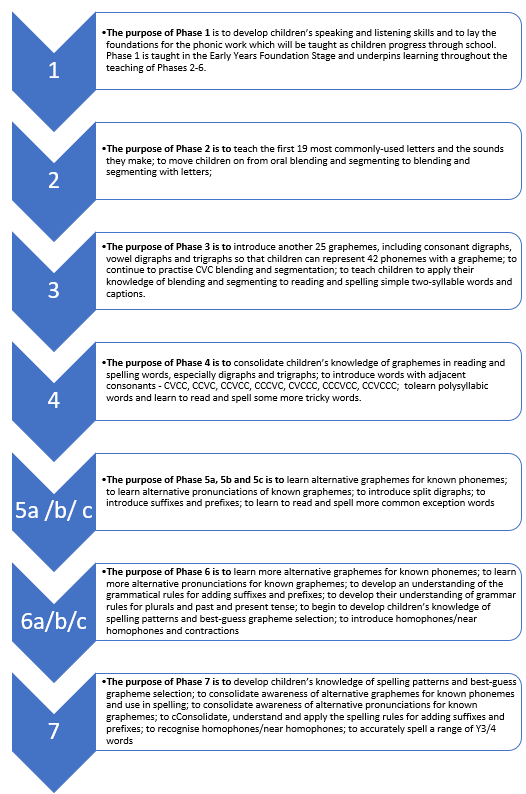
- Children engage in hands-on activities to develop Phase 1 phonics skills, including the seven aspects of sound discrimination.
- Reception focuses on hearing phonemes, recognising and writing graphemes, blending for reading, and segmenting for spelling.
- Daily phonics lessons follow a revisit, teach, practice, apply structure.
- Reading materials and book bands are matched to children’s phonics phases.
Key Stage 1
- Year 1 consolidates Phases 3-5, teaching alternative phonemes (5a, 5b, 5c).
- Lessons remain multisensory and follow the revisit-teach-practice-apply model.
- Assessment informs teaching and targeted interventions ensure all children progress.
- Children complete the Year 1 Phonics Screening Check in the Summer Term.
- Year 2 extends learning into Phase 6: alternative pronunciations, suffixes, prefixes, contractions, and homophones, reinforcing spelling skills.
- Children continue to use phonically decodable texts matched to their ability.
- Children who did not pass the Year 1 check receive targeted support and re-sit the screening in Year 2.
Key Stage 2
- Ongoing phonics intervention supports children below age-related expectations.
- Twinkl Codebreakers or Schofield and Sims intervention schemes are used where needed.
Pedagogy – How we deliver phonics
From Phases 2-7 the structure of Phonics lessons follow a familiar five-part structure to ensure that the four cornerstones of phonics teaching are covered.
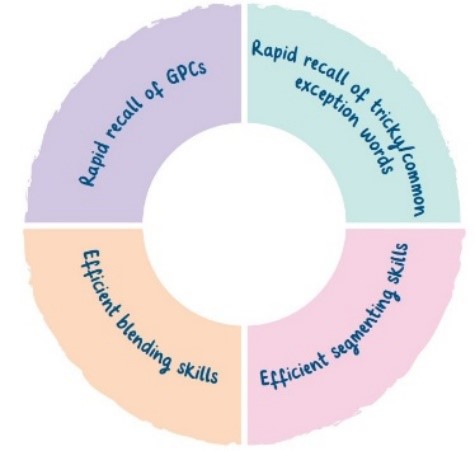
Lessons typically follow a 5 part structure – revisit and review, teach, practise, apply, assess. This ensures that children know how the lesson progresses and are prepared for and can anticipate each part. Having this routine helps the children focus directly on the learning.
The teaching of some tricky words are embedded throughout the planning and are to be taught in context not separately. Further development of this skill is supported by the Action Words programme.
Impact
By the end of each phase, children are able to:
- Read fluently and with understanding
- Spell accurately using phonics strategies
- Apply phonics skills confidently in their reading and writing
Progress is monitored using Guided Reading Assessments and the SONAR tracking system, ensuring every child achieves their full potential.
At Barley Fields, our phonics curriculum equips children with the foundations for lifelong reading and writing success.